Neuromorphic Computing: U.S. Developer’s 2026 Competitive Edge
The technological landscape is constantly evolving, driven by an insatiable demand for faster, more efficient, and intelligent systems. As we push the boundaries of artificial intelligence (AI) and machine learning (ML), traditional computing architectures are beginning to show their limitations, particularly in energy consumption and parallel processing capabilities. This is where neuromorphic computing U.S. steps in, offering a revolutionary paradigm shift inspired by the structure and function of the human brain.
For U.S. developers, understanding and adopting neuromorphic computing isn’t just about staying current; it’s about securing a significant competitive edge. By 2026, experts predict that early adopters of this technology could see as much as a 20% advantage in performance, efficiency, and innovation. This article delves into what neuromorphic computing entails, why it’s crucial for U.S. developers, its current applications, future potential, and the skills required to harness its power.
What is Neuromorphic Computing?
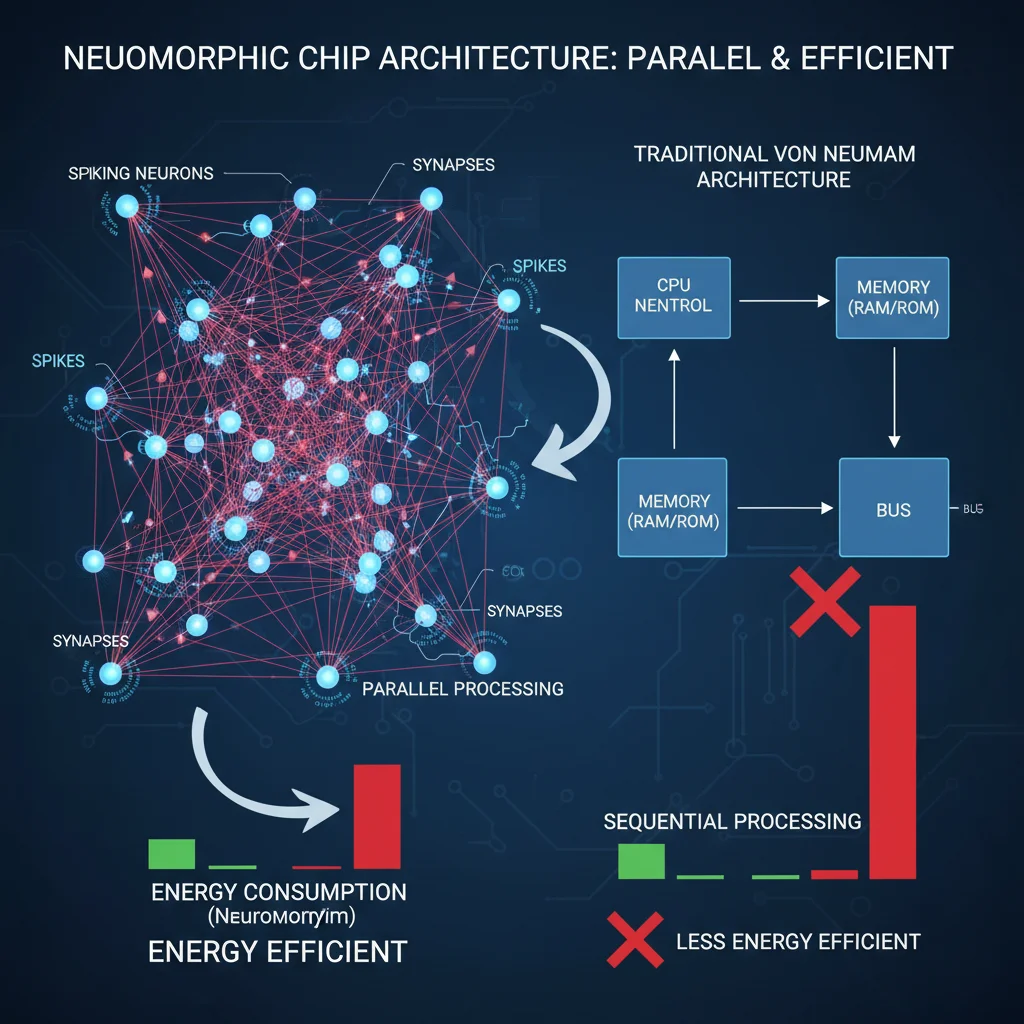
At its core, neuromorphic computing is an engineering approach that mimics the neuro-biological architectures present in the nervous system. Unlike traditional Von Neumann architectures, which separate processing and memory units, neuromorphic systems integrate these functions, much like neurons and synapses in the brain. This ‘in-memory computing’ approach drastically reduces the need to move data between different components, thereby significantly lowering energy consumption and increasing processing speed for specific tasks.
Key characteristics of neuromorphic systems include:
- Spiking Neural Networks (SNNs): Instead of continuous values, SNNs communicate through discrete ‘spikes’ or pulses, similar to biological neurons. This event-driven communication is highly energy-efficient.
- Parallel Processing: Neuromorphic chips are designed for massive parallelism, allowing many computations to occur simultaneously, which is ideal for complex AI tasks.
- Adaptive Learning: These systems can learn and adapt over time, often without explicit programming, mirroring the brain’s plasticity.
- Low Power Consumption: By processing data where it’s stored and using event-driven communication, neuromorphic chips consume significantly less power than conventional CPUs or GPUs for certain workloads.
The goal is not to perfectly replicate the brain but to draw inspiration from its efficiency and learning capabilities to build more powerful and sustainable AI hardware. This field of neuromorphic computing U.S. is seeing substantial investment and research, positioning it as a cornerstone of future AI development.
Why a 20% Competitive Edge by 2026 for U.S. Developers?
The promise of a 20% competitive edge by 2026 is not an exaggeration; it’s a conservative estimate based on the unique advantages neuromorphic computing offers. For U.S. developers, this edge will manifest in several critical areas:
Superior Performance in AI Workloads
Traditional hardware struggles with the sheer volume and complexity of data required for advanced AI, particularly in real-time scenarios. Neuromorphic chips excel at pattern recognition, anomaly detection, and continuous learning tasks, making them ideal for:
- Edge AI: Deploying sophisticated AI models directly on devices with limited power and computational resources, such as autonomous vehicles, IoT sensors, and robotics. This reduces latency and reliance on cloud infrastructure.
- Real-time Analytics: Processing vast streams of sensor data or financial transactions in milliseconds, providing instant insights and decision-making capabilities.
- Complex Optimization Problems: Solving intricate optimization challenges more efficiently than traditional algorithms.
Unprecedented Energy Efficiency
As AI models grow larger and more complex, their energy footprint becomes a major concern. Neuromorphic systems, with their inherent energy efficiency, offer a sustainable solution. For data centers, this translates to lower operational costs and a reduced environmental impact. For mobile and embedded devices, it means longer battery life and the ability to perform complex AI tasks on device without constant recharging or external power.
Accelerated Innovation and Development Cycles
Developers who master neuromorphic computing U.S. will be able to design and deploy AI solutions that are currently impractical or impossible with conventional hardware. This opens up new avenues for innovation in fields like personalized medicine, advanced robotics, and intelligent infrastructure. The ability to prototype and iterate on these novel solutions faster will give early adopters a significant lead.
Strategic National Advantage
The U.S. is a global leader in technological innovation. Investing in and developing expertise in neuromorphic computing will solidify this position, creating new industries, high-skilled jobs, and enhancing national security through advanced AI capabilities. Companies and developers who are at the forefront of this technology will attract top talent and investment, further widening the competitive gap.
Current Applications and Early Successes
While still an emerging field, neuromorphic computing has already demonstrated impressive capabilities in various domains. Several prominent U.S. companies and research institutions are actively developing and deploying these systems:
IBM’s TrueNorth
One of the earliest and most well-known neuromorphic chips, IBM’s TrueNorth, was designed to mimic the brain’s structure with millions of neurons and billions of synapses. It excels at pattern recognition tasks with extremely low power consumption, making it suitable for applications like real-time video analysis and cognitive computing at the edge.
Intel’s Loihi
Intel’s Loihi research chip is another significant player in the neuromorphic computing U.S. landscape. Loihi is designed to support a variety of learning and adaptation algorithms on-chip. It has been successfully applied to:
- Robotics: Enabling robots to learn and adapt to new environments more efficiently.
- Sensor Fusion: Processing data from multiple sensors (e.g., visual, auditory, tactile) in real-time for improved perception.
- Optimization Problems: Solving complex combinatorial optimization problems faster and with less energy than traditional methods.
- Gesture Recognition: Real-time, low-power gesture recognition for human-computer interaction.
Graphcore’s IPU (Intelligence Processing Unit)
While not strictly neuromorphic in the spiking neural network sense, Graphcore’s IPUs share some foundational principles of parallel processing and in-memory computation for AI workloads. They represent a departure from traditional CPU/GPU architectures, demonstrating the industry’s move towards specialized hardware for AI.
Academic Research and Startups
Numerous U.S. universities and startups are making significant strides in neuromorphic hardware and software development. Projects at institutions like Stanford, MIT, and Purdue are exploring novel materials, chip designs, and algorithms to push the boundaries of what’s possible. Startups are emerging with specialized solutions for specific industries, from healthcare to industrial automation, leveraging the unique strengths of neuromorphic approaches.
Challenges and Considerations for U.S. Developers
While the benefits are clear, adopting neuromorphic computing is not without its challenges. U.S. developers need to be aware of these hurdles to effectively integrate this technology into their workflows.
Programming Model and Tooling
One of the biggest obstacles is the fundamentally different programming model. Neuromorphic chips are not programmed like traditional CPUs. They often require specialized languages, frameworks, and simulation tools to design and train SNNs. Developers will need to learn new paradigms, moving away from sequential instruction sets to event-driven, parallel computation.
Algorithm Development
Translating existing AI algorithms, particularly those based on backpropagation for deep learning, to neuromorphic architectures is an active area of research. While some algorithms can be adapted, others may require entirely new approaches tailored to spiking networks. This presents both a challenge and an opportunity for innovation in algorithm design.
Hardware Accessibility and Cost
Currently, neuromorphic hardware is not as widely available or as cost-effective as traditional GPUs. Access to development kits and specialized chips is often limited to research institutions and large corporations. However, as the technology matures and demand increases, costs are expected to decrease, and accessibility will improve.
Integration with Existing Systems
Integrating neuromorphic co-processors or accelerators into existing computing infrastructure can be complex. Developers will need to consider how these specialized units communicate with conventional CPUs and GPUs, manage data flow, and ensure seamless operation within larger systems.
Skills and Knowledge for the Future-Ready U.S. Developer
To gain that 20% competitive edge by 2026, U.S. developers should start acquiring relevant skills now. Here’s a roadmap for success:
1. Foundational AI and Machine Learning
A strong understanding of traditional AI and ML concepts remains crucial. This includes:
- Neural Networks: Deep understanding of various neural network architectures (CNNs, RNNs, Transformers).
- Machine Learning Algorithms: Familiarity with supervised, unsupervised, and reinforcement learning.
- Data Science Fundamentals: Data preprocessing, feature engineering, model evaluation.
2. Spiking Neural Networks (SNNs)
This is the core of neuromorphic software development. Developers should focus on:
- SNN Principles: How SNNs work, spiking mechanisms, synaptic plasticity.
- SNN Frameworks: Learning frameworks like Brian2, NEST, or specialized tools provided by hardware vendors (e.g., Intel’s Lava for Loihi).
- Event-Driven Programming: Adapting to a programming style where computation is triggered by events (spikes) rather than synchronous clocks.
3. Hardware-Software Co-Design
Understanding the interplay between neuromorphic hardware and software is vital. This includes:
- Chip Architectures: Basic knowledge of how neuromorphic chips are designed and how their physical constraints impact software performance.
- Resource Management: Optimizing algorithms for limited on-chip memory and computational resources.
4. Parallel and Distributed Computing
Neuromorphic systems are inherently parallel. Experience with parallel programming paradigms and distributed systems will be highly beneficial.
5. Domain-Specific Knowledge
For specific applications (e.g., robotics, computer vision, natural language processing), deep domain expertise will allow developers to identify opportunities where neuromorphic computing U.S. can provide the most significant advantage.
6. Continuous Learning and Research
The field is rapidly evolving. Staying updated with the latest research papers, attending conferences, and participating in online communities will be essential for U.S. developers to remain at the forefront.

Future Trends and Opportunities
The trajectory of neuromorphic computing points towards a future filled with exciting possibilities:
Hybrid Architectures
It’s unlikely that neuromorphic chips will entirely replace traditional CPUs/GPUs in the short term. Instead, we’ll see more hybrid systems where neuromorphic accelerators handle specific, energy-intensive AI tasks, while conventional processors manage general-purpose computing. This synergistic approach will maximize the strengths of both.
Advanced Materials and Fabrication
Research into novel materials like memristors and phase-change memory will lead to even more compact, energy-efficient, and brain-like computing elements, further advancing the field of neuromorphic computing U.S.
Large-Scale Neuromorphic Systems
As technology matures, we can expect to see the development of larger and more complex neuromorphic systems, potentially reaching brain-scale complexity, opening doors to truly cognitive AI.
Democratization of Tools and Platforms
Just as machine learning frameworks like TensorFlow and PyTorch have democratized AI development, we can anticipate similar user-friendly platforms and cloud services emerging for neuromorphic computing, making it accessible to a wider range of developers.
Ethical AI and Explainability
The brain-inspired nature of neuromorphic systems may also contribute to advancements in explainable AI, as their operations might be more interpretable than opaque deep learning models, addressing growing concerns about AI ethics and transparency.
Conclusion: Seizing the Neuromorphic Advantage
The rise of neuromorphic computing represents a pivotal moment in the history of computing. For U.S. developers, it’s not just another technological trend; it’s a fundamental shift that promises to redefine the boundaries of AI, efficiency, and innovation. The opportunity to gain a 20% competitive edge by 2026 is real and tangible, but it requires proactive engagement, continuous learning, and a willingness to embrace new paradigms.
By investing in the necessary skills, exploring available hardware and software platforms, and participating in the growing community, U.S. developers can position themselves at the forefront of this revolution. The future of AI is intelligent, efficient, and brain-inspired, and those who master neuromorphic computing U.S. will undoubtedly lead the way.
The time to act is now. Start exploring, start learning, and prepare to build the next generation of intelligent systems that will shape our world.