Space Commercialization: Top 5 U.S. Growth Opportunities by 2030

The cosmos, once the exclusive domain of government agencies, has rapidly transformed into the next great frontier for commercial enterprise. The United States, a historical leader in space exploration, is now at the forefront of this burgeoning space commercialization revolution. With advancements in technology, decreasing launch costs, and an insatiable demand for space-based services, the U.S. space economy is projected for unprecedented growth. Experts forecast certain sectors within space commercialization opportunities to expand by a staggering 50% annually through 2030, presenting lucrative prospects for innovation and investment.
This article delves into five pivotal U.S. opportunities within space commercialization that are expected to drive this extraordinary growth. We will explore the underlying factors fueling their expansion, the key players, and the transformative impact they are poised to have on our world and beyond. Understanding these trends is crucial for anyone looking to navigate or invest in the future of the space economy.
The Dawn of a New Space Age: Understanding Space Commercialization
Space commercialization refers to the private sector’s increasing involvement in space-related activities, traditionally dominated by government entities. This includes everything from manufacturing satellites and launch vehicles to providing space-based services like internet connectivity, Earth observation, and even space tourism. The shift is driven by several factors:
- Technological Advancements: Miniaturization of satellites, reusable rocket technology, and advanced robotics have significantly lowered the barriers to entry.
- Decreasing Costs: Reusable rockets, championed by companies like SpaceX, have dramatically reduced the cost per launch, making space more accessible.
- Increased Demand: A global appetite for high-speed internet, precise navigation, climate monitoring, and secure communication fuels the need for more space infrastructure.
- Government Support: U.S. government agencies like NASA are increasingly partnering with private companies, fostering innovation and creating a robust ecosystem for commercial growth.
The U.S. holds a unique position in this landscape, boasting a strong entrepreneurial spirit, a deep talent pool, and significant investment capital. This confluence of factors positions the nation to lead the charge in unlocking the full potential of space commercialization opportunities.
Opportunity 1: Satellite Internet Constellations and Global Connectivity
One of the most transformative space commercialization opportunities is the deployment of vast satellite internet constellations. Companies like Starlink (SpaceX) and Project Kuiper (Amazon) are leading this charge, aiming to provide high-speed, low-latency internet access to underserved and remote areas globally. The market for satellite internet is exploding, driven by the increasing demand for seamless connectivity across all sectors, from rural households to maritime operations and aviation.
Market Dynamics and Growth Drivers
The global satellite internet market was valued at billions of dollars in recent years and is projected to see exponential growth. The 50% annual growth target for this sector through 2030 is highly plausible due to:
- Unmet Demand: Billions of people worldwide still lack reliable internet access. Satellite internet offers a viable solution where traditional fiber optic infrastructure is impractical or too expensive.
- Technological Maturity: Advances in phased-array antennas, inter-satellite laser links, and high-throughput satellites (HTS) are making these constellations more efficient and cost-effective.
- Competitive Pricing: As more players enter the market and technology improves, the cost of satellite internet services is becoming competitive with, and in some cases, superior to terrestrial alternatives.
- Integration with 5G/6G: Satellite networks are increasingly seen as a crucial component for future 5G and 6G infrastructure, providing backhaul and coverage extension.
Key Players and Innovation
The U.S. is home to the pioneers of this revolution. SpaceX’s Starlink has already deployed thousands of satellites, providing service to hundreds of thousands of subscribers. Amazon’s Project Kuiper is rapidly developing its own constellation, with significant investment in manufacturing and launch capabilities. Other companies are also eyeing this market, leading to a vibrant ecosystem of innovation and competition.
The economic impact of these constellations extends beyond just internet provision. They create demand for satellite manufacturing, launch services, ground infrastructure, and a plethora of ancillary services, making it a cornerstone of future space commercialization opportunities.

Opportunity 2: In-Orbit Manufacturing and Servicing (IOS)
Another rapidly emerging and high-growth area in space commercialization is In-Orbit Manufacturing and Servicing (IOS). This encompasses a range of activities, including:
- Satellite Servicing: Refueling, repairing, upgrading, or relocating existing satellites to extend their operational lifespan.
- In-Orbit Assembly: Constructing large structures in space that are too big or complex to launch fully assembled from Earth.
- Space Manufacturing: Producing new materials or components in the microgravity environment of space, potentially leading to novel alloys, pharmaceuticals, or semiconductor materials with unique properties.
- De-orbiting and Debris Removal: Addressing the growing problem of space debris by actively removing defunct satellites and rocket stages.
The Economic Imperative for IOS
The drivers for IOS are compelling:
- Cost Savings: Extending the life of expensive satellites through servicing can save billions compared to launching replacements.
- Enhanced Capabilities: Manufacturing in space can unlock new material properties and enable the construction of larger, more powerful space assets.
- Sustainability: Debris removal is becoming critical for the long-term viability of space operations, making it a significant future market.
- Flexibility: The ability to upgrade or reconfigure satellites in orbit offers unprecedented operational flexibility.
Several U.S. companies are at the forefront of this technology. Maxar Technologies and Northrop Grumman have demonstrated satellite servicing capabilities, while startups like Made In Space (now part of Redwire) are exploring additive manufacturing in space. The regulatory framework is also evolving to support these complex operations, paving the way for substantial growth in space commercialization opportunities.
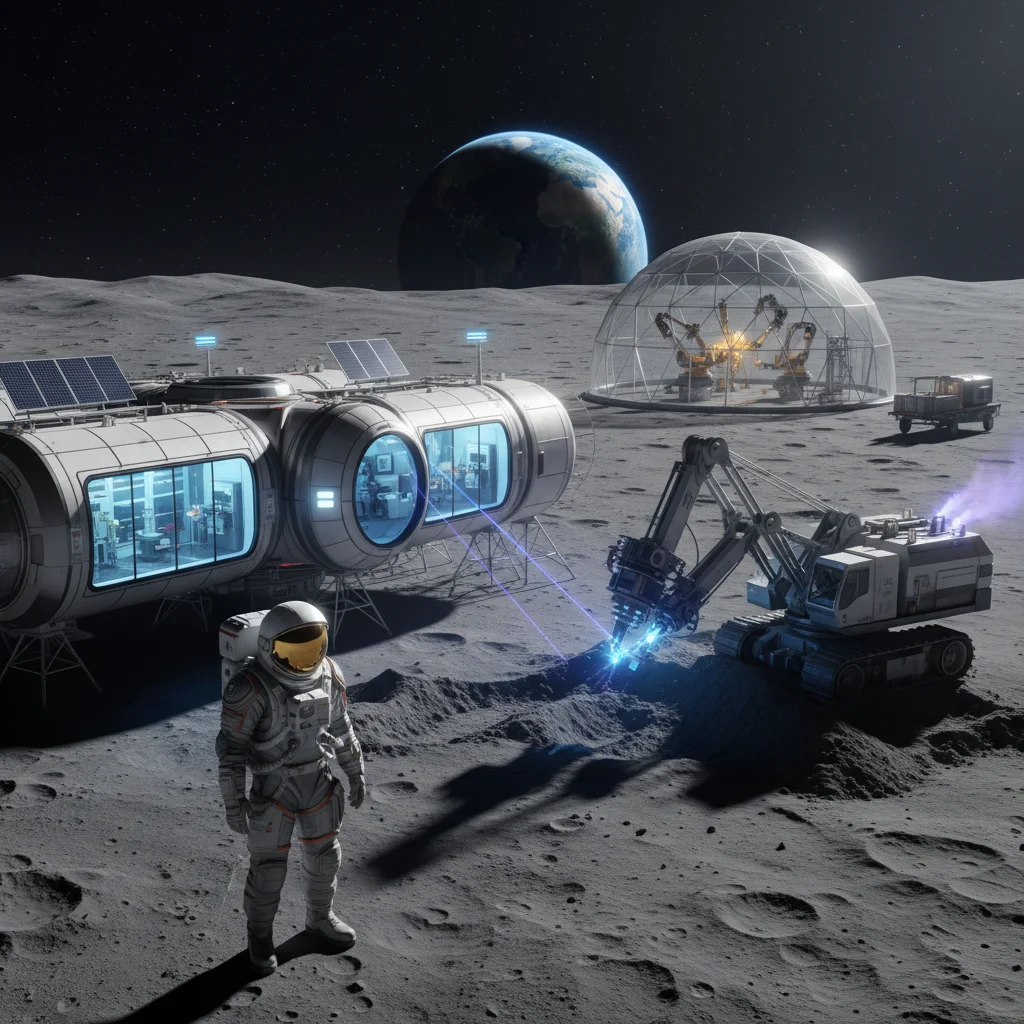
Opportunity 3: Lunar and Martian Resource Utilization (In-Situ Resource Utilization – ISRU)
The long-term vision for space commercialization extends beyond Earth orbit to celestial bodies like the Moon and Mars. Lunar and Martian Resource Utilization (ISRU) involves extracting and processing raw materials found on these bodies for use in space. This includes:
- Water Ice Extraction: Crucial for drinking water, oxygen for life support, and hydrogen/oxygen propellant for rockets.
- Regolith Processing: Using lunar soil (regolith) for construction materials, radiation shielding, or extracting metals.
- Helium-3 Mining: A potential future fuel source for nuclear fusion reactors, abundant on the Moon.
Why ISRU is a Game Changer
ISRU is not just about scientific exploration; it’s a fundamental pillar for sustainable and affordable long-duration space missions and eventual off-world settlements. Transporting all necessary resources from Earth is prohibitively expensive. By ‘living off the land,’ future missions can reduce launch mass and cost significantly, making deep space exploration and colonization economically viable.
NASA’s Artemis program, with its goal of returning humans to the Moon and establishing a sustained presence, is a major catalyst for ISRU development. U.S. companies like Astrobotic Technology, Intuitive Machines, and Lunar Outpost are developing lunar landers and rovers equipped with ISRU technologies. These companies are not only aiming to deliver payloads to the Moon but also to demonstrate the feasibility of extracting resources, opening up immense space commercialization opportunities.
The projected 50% annual growth is driven by the foundational nature of ISRU for future space endeavors. As more missions target the Moon and Mars, the demand for ISRU technologies and services will skyrocket.
Opportunity 4: Advanced Earth Observation and Geospatial Intelligence
Earth observation (EO) from space has been a critical tool for decades, but the commercial sector is now revolutionizing its capabilities and applications. Advanced EO and geospatial intelligence represent another high-growth area within space commercialization opportunities. This involves:
- High-Resolution Imaging: Capturing incredibly detailed images of Earth’s surface for various applications.
- Hyperspectral Imaging: Collecting data across a wide spectrum of light to identify specific materials and conditions.
- Synthetic Aperture Radar (SAR): Providing all-weather, day-and-night imaging capabilities, crucial for monitoring changes regardless of cloud cover.
- Data Analytics and AI: Processing vast amounts of satellite data using artificial intelligence and machine learning to extract actionable insights.
Transformative Applications and Market Expansion
The applications for advanced EO are diverse and impactful:
- Agriculture: Monitoring crop health, predicting yields, and optimizing irrigation.
- Environmental Monitoring: Tracking deforestation, glacier melt, pollution, and natural disasters.
- Urban Planning: Mapping urban sprawl, infrastructure development, and traffic patterns.
- Defense and Intelligence: Providing critical intelligence for national security.
- Financial Services: Analyzing economic activity, such as tracking retail foot traffic or oil storage levels.
U.S. companies like Planet Labs, Maxar Technologies, and Capella Space are deploying constellations of small satellites to provide unprecedented revisit rates and data granularity. The ability to monitor changes on Earth almost in real-time creates new markets and enhances existing ones, fueling the projected 50% annual growth. The demand for timely, accurate, and comprehensive geospatial data is only increasing across government, commercial, and scientific sectors, solidifying its place as a prime area for space commercialization opportunities.
Opportunity 5: Space Tourism and Commercial Human Spaceflight
What was once the stuff of science fiction is now becoming a reality: space tourism and commercial human spaceflight. This sector involves private companies offering suborbital and orbital flights to paying customers, as well as providing transportation services for government astronauts and private researchers to destinations like the International Space Station (ISS) and future commercial space stations.
The Allure of the Final Frontier and Economic Impact
While still in its nascent stages, space tourism is poised for explosive growth, driven by the inherent human desire to explore and experience the extraordinary. The 50% annual growth projection for this sector through 2030 reflects the significant upfront investment, the high value per customer, and the anticipated increase in accessible options.
- Suborbital Flights: Companies like Virgin Galactic and Blue Origin are offering short trips to the edge of space, allowing passengers to experience weightlessness and see the curvature of the Earth.
- Orbital Flights: SpaceX’s Crew Dragon has already flown private citizens to orbit, and future missions promise longer stays in space, potentially on private space stations.
- Space Station Development: Companies like Axiom Space are developing commercial modules for the ISS and planning entirely private space stations, creating destinations for tourists, researchers, and even commercial manufacturing.
The U.S. is leading this charge, with companies like SpaceX, Blue Origin, and Virgin Galactic pushing the boundaries of what’s possible. Beyond the direct revenue from ticket sales, this sector stimulates innovation in spacecraft design, life support systems, and ground infrastructure. It also inspires a new generation of scientists and engineers, contributing to the broader ecosystem of space commercialization opportunities.
Challenges and Considerations for Space Commercialization
While the prospects for these space commercialization opportunities are incredibly bright, it’s important to acknowledge the challenges:
- Regulatory Landscape: The rapid pace of innovation often outstrips existing regulations, leading to uncertainty regarding licensing, liability, and international agreements.
- High Capital Investment: Developing space-grade technology and infrastructure requires substantial upfront capital, though this is being mitigated by private investment and government partnerships.
- Technical Risks: Space operations inherently carry technical risks, from launch failures to in-orbit malfunctions.
- Space Debris: The increasing number of satellites and missions exacerbates the problem of space debris, posing a threat to operational spacecraft.
- Sustainability and Environmental Impact: Concerns about the environmental impact of increased rocket launches and satellite disposal need to be addressed.
Addressing these challenges will be crucial for sustaining the projected growth and ensuring the long-term viability of space commercialization. The U.S. government, through agencies like the FAA, FCC, and NASA, is actively working with industry to develop frameworks that foster innovation while ensuring safety and sustainability.
The Future is Now: Investing in Space Commercialization Opportunities
The U.S. space commercialization sector is not just a niche market; it is a rapidly expanding economic frontier with the potential to reshape industries and human civilization. The five opportunities discussed – satellite internet, in-orbit manufacturing and servicing, lunar/Martian resource utilization, advanced Earth observation, and space tourism – represent the vanguard of this transformation.
With projections of 50% annual growth through 2030 in these key areas, the investment potential is immense. Private equity, venture capital, and even public markets are increasingly drawn to the promise of the space economy. For entrepreneurs, engineers, and visionaries, the call to innovate in space has never been stronger.
As technology continues to advance and costs continue to fall, access to space will become even more democratized, unlocking further space commercialization opportunities that are yet to be imagined. The journey from government-led exploration to private enterprise-driven innovation is well underway, and the United States is poised to lead the world into this exciting new era of cosmic commerce.
The next decade will undoubtedly be a period of unprecedented expansion and discovery in space. By focusing on these high-growth sectors, the U.S. can solidify its leadership, create new jobs, drive technological breakthroughs, and inspire a new generation to look upwards and beyond.