Mastering Agile A/B Testing: 5 Tests Monthly for 10% Conversion Uplift by 2026

Mastering Agile A/B Testing: Running 5 Tests Monthly for a 10% Conversion Uplift by 2026
In the dynamic world of digital marketing and product development, staying competitive means constantly evolving. The key to this evolution lies in understanding your users and optimizing their experience. This is where agile A/B testing becomes not just a tool, but a fundamental strategy for sustained growth. Imagine achieving a remarkable 10% conversion uplift by 2026, driven by a consistent rhythm of running at least five A/B tests every single month. This isn’t just an ambitious goal; it’s an achievable reality with the right framework and mindset.
The digital landscape is littered with assumptions. What we *think* users want, what *we believe* will improve conversion, often falls short in practice. Agile A/B testing provides the scientific rigor needed to move beyond guesswork. By systematically testing different variations of your website, app, or marketing campaigns, you gather empirical evidence that directly informs your decisions. This article will delve deep into establishing a robust agile A/B testing program, outlining the methodologies, tools, and cultural shifts required to transform your experimentation efforts into a powerful engine for conversion rate optimization (CRO).
The Imperative of Agile A/B Testing in Today’s Digital Ecosystem
Why is agile A/B testing more critical now than ever before? The answer lies in the accelerating pace of change and the increasing sophistication of customer expectations. Users demand seamless, intuitive, and personalized experiences. Companies that fail to adapt quickly risk being left behind. Traditional, slow-moving testing processes simply cannot keep up. Agile methodologies, characterized by iterative cycles, rapid deployment, and continuous feedback, are perfectly suited to the demands of modern CRO.
Breaking Down the ‘Agile’ in A/B Testing
Agile, in the context of A/B testing, means adopting a flexible, iterative approach to experimentation. Instead of large, infrequent tests that take months to plan and execute, agile testing emphasizes smaller, focused experiments launched frequently. This allows for:
- Faster Learning Cycles: Quick feedback loops mean you learn what works (and what doesn’t) much faster.
- Reduced Risk: Smaller tests mean less potential negative impact if a hypothesis proves incorrect.
- Continuous Optimization: Rather than one-off improvements, you’re building a culture of ongoing enhancement.
- Adaptability: You can pivot strategies based on real-time data, responding to market changes or new user behaviors.
The goal of running five A/B tests monthly isn’t arbitrary. It’s about building momentum, fostering a culture of experimentation, and generating a continuous stream of insights that compound over time. Each successful test, no matter how small the uplift, contributes to the overarching goal of a 10% conversion increase by 2026.
Setting the Stage for Success: Foundations of a High-Velocity Testing Program
Before you can embark on a journey of five tests monthly, you need solid foundations. This involves establishing clear goals, building the right team, and selecting the appropriate tools.
Defining Your North Star: The 10% Conversion Uplift by 2026
A clear, measurable objective like “10% conversion uplift by 2026” provides focus and motivation. But this overarching goal needs to be broken down into smaller, actionable targets. What does a 10% uplift mean for your specific business? Is it a 10% increase in sales, leads, sign-ups, or another critical metric? Define your primary conversion goal and ensure everyone understands it.
- Identify Key Conversion Points: Pinpoint the most critical steps in your user journey where conversion happens (e.g., product page views, add-to-cart, checkout completion, form submissions).
- Establish Baseline Metrics: Understand your current conversion rates for these key points. This is your starting line.
- Quantify the Impact: Calculate what a 10% uplift on these baselines would mean in terms of revenue, leads, or other business value. This helps in prioritizing tests.
Building Your Experimentation Dream Team
Agile A/B testing is not a solo endeavor. It requires a cross-functional team with diverse skill sets:
- Experimentation Lead/CRO Manager: Oversees the entire program, sets strategy, prioritizes tests, and ensures alignment with business goals.
- UX/UI Designer: Crafts test variations, ensuring they are user-friendly and aesthetically pleasing.
- Developer/Engineer: Implements tests, ensures technical integrity, and helps with data layer implementation.
- Analyst/Data Scientist: Designs experiments, monitors test validity, performs statistical analysis, and extracts actionable insights.
- Copywriter/Content Strategist: Develops compelling messaging for test variations.
- Product Manager/Business Stakeholder: Provides context, defines business problems, and ensures tests align with product roadmap.
For smaller organizations, individuals might wear multiple hats, but the key is to ensure all these functions are covered. Collaboration and clear communication are paramount.
Selecting the Right Tools for Agile A/B Testing
The right tech stack can significantly accelerate your agile A/B testing efforts. Essential tools include:
- A/B Testing Platform: Optimizely, VWO, Google Optimize (though sunsetting), Adobe Target, or similar. Choose a platform that offers robust features, easy implementation, and reliable reporting.
- Analytics Platform: Google Analytics 4, Adobe Analytics, Mixpanel. Essential for understanding user behavior, identifying opportunities, and validating test results.
- Heatmaps and Session Replay Tools: Hotjar, FullStory, Crazy Egg. These provide qualitative insights into *why* users behave the way they do, helping to generate better hypotheses.
- Survey Tools: Qualaroo, SurveyMonkey. Directly ask users about their pain points and motivations.
- Project Management Tool: Jira, Trello, Asana. For managing the backlog of test ideas, tracking progress, and assigning tasks.
The Agile A/B Testing Cycle: From Hypothesis to Implementation
Running five tests monthly demands a streamlined, repeatable process. This agile cycle can be broken down into distinct, iterative phases:
1. Hypothesis Generation: The Foundation of Every Test
Every good A/B test starts with a strong hypothesis. A hypothesis is an educated guess about how a change will impact user behavior and why. It should follow the format: “If we [make this change], then [this outcome] will happen, because [this reason].”
- Data-Driven Insights: Don’t guess. Use quantitative data (analytics, heatmaps, session recordings) and qualitative data (user surveys, interviews, customer support feedback) to identify pain points and opportunities.
- Prioritization Frameworks: With potentially dozens of ideas, use frameworks like ICE (Impact, Confidence, Ease) or PIE (Potential, Importance, Ease) to prioritize which hypotheses to test first. This ensures you’re working on tests with the highest potential return.
- Specificity is Key: A vague hypothesis leads to vague results. Be specific about the change you’re proposing and the expected outcome.
2. Experiment Design: Crafting Your Variations
Once you have a prioritized hypothesis, it’s time to design the experiment. This involves creating the control (current version) and one or more variations.
- Isolate Variables: Ideally, test only one major change per experiment. This makes it easier to attribute results to a specific modification. If you test too many things at once, you won’t know which element caused the uplift (or decline).
- Statistical Rigor: Determine the required sample size and duration for your test to achieve statistical significance. Tools can help with this, but understanding the basics of statistical power is crucial.
- Define Success Metrics: Clearly define your primary metric (e.g., conversion rate) and secondary metrics (e.g., engagement, time on page) that you’ll track.
- Technical Setup: Work with your development team to ensure the test can be implemented correctly and won’t introduce bugs or performance issues.
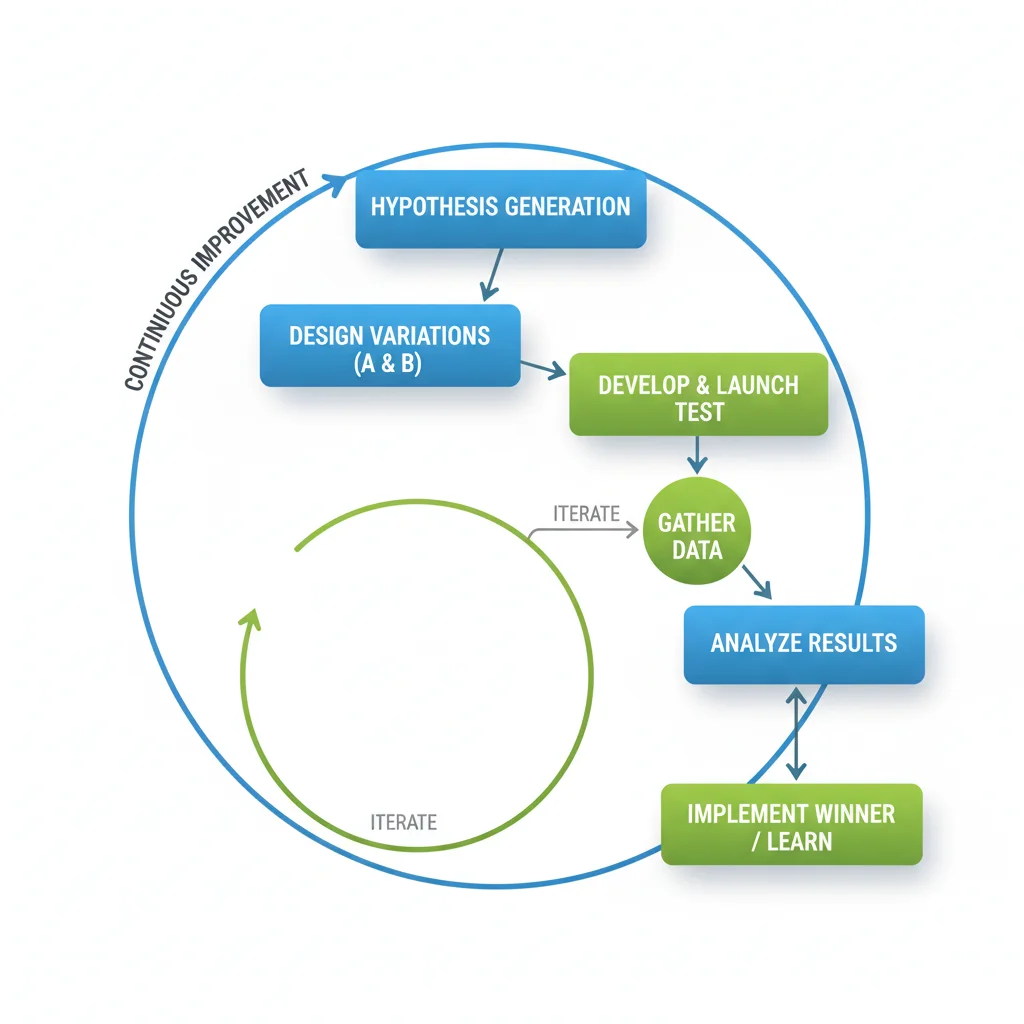
3. Implementation and Launch: Getting Your Test Live
This phase involves coding the variations and deploying them using your A/B testing platform.
- Quality Assurance (QA): Thoroughly test all variations on different browsers, devices, and screen sizes to ensure they function as intended and look consistent. A broken test yields invalid results.
- Tracking Verification: Double-check that all conversion events and metrics are being tracked correctly by both your A/B testing platform and your analytics tool.
- Segment Targeting: Ensure your test traffic is correctly segmented if you’re targeting specific user groups.
- Gradual Rollout (Optional): For high-stakes tests, consider a gradual rollout to a small percentage of traffic before expanding to the full audience.
4. Monitoring and Analysis: Interpreting the Data
Once your test is live, continuous monitoring is essential. Don’t just set it and forget it.
- Monitor Key Metrics: Keep an eye on your primary and secondary metrics. Look for anomalies or technical issues.
- Statistical Significance: Wait until your test reaches statistical significance before drawing conclusions. Ending a test too early or too late can lead to misleading results.
- Segmented Analysis: Analyze results across different user segments (e.g., new vs. returning users, mobile vs. desktop, specific traffic sources). You might find that a variation performs well for one segment but poorly for another.
- Qualitative Insights: Supplement quantitative data with qualitative insights from heatmaps, session recordings, and user feedback. This helps you understand the ‘why’ behind the numbers.
5. Decision and Iteration: Learning and Moving Forward
Based on your analysis, you’ll make a decision about the test variation.
- Implement the Winner: If a variation significantly outperforms the control, implement it as the new default.
- Learn from Losers: Even if a variation doesn’t win, you’ve learned something valuable. Document these learnings. Why didn’t it work? This informs future hypotheses.
- Iterate: A winning test isn’t the end; it’s often the beginning of the next test. How can you further optimize the winning variation? This continuous iteration is the essence of agile A/B testing.
- Document Results: Maintain a clear record of all tests, hypotheses, results, learnings, and their business impact. This knowledge base is invaluable for future experimentation.
Strategies for Achieving 5 A/B Tests Monthly
Running five tests monthly is an ambitious but attainable goal. It requires discipline, efficiency, and a culture that embraces experimentation. Here are strategies to help you achieve this velocity:
1. Prioritize Small, Impactful Tests
Not every test needs to be a complete redesign. Often, small changes can yield significant results. Focus on micro-optimizations that are quick to implement and analyze. Examples include:
- Headline variations
- Call-to-action button text or color changes
- Image or video placement
- Form field optimizations
- Minor layout adjustments
These smaller tests free up resources for occasional larger, more complex experiments.
2. Develop a Robust Hypothesis Backlog
Never run out of ideas. Maintain a constantly updated backlog of hypotheses, drawing from:
- User research and feedback
- Analytics data (identifying drop-off points, high exit rates)
- Competitor analysis
- Industry best practices and trends
- Brainstorming sessions with your team
Regularly review and prioritize this backlog to ensure a steady stream of ready-to-test ideas.
3. Streamline Your Review and Approval Process
Bureaucracy can kill testing velocity. Establish a clear, efficient process for reviewing and approving test designs and variations. Empower your experimentation team to make quick decisions within defined guardrails.
4. Automate Where Possible
Leverage your A/B testing platform’s features to automate test setup, deployment, and even some aspects of reporting. Integrate your testing platform with your analytics tools to minimize manual data extraction and analysis.
5. Foster a Culture of Experimentation
This is perhaps the most crucial element. Encourage everyone in the organization to think experimentally. Celebrate both wins and learnings. Frame failed tests not as failures, but as valuable insights that prevent costly mistakes down the line. Share results widely to build enthusiasm and show the tangible impact of agile A/B testing.
6. Dedicate Resources
Treat experimentation as a core business function, not an afterthought. Allocate dedicated time, budget, and personnel to your A/B testing program. Without proper resources, maintaining a high testing velocity is nearly impossible.
Overcoming Challenges in High-Velocity A/B Testing
While the benefits of agile A/B testing are clear, implementing a high-velocity program comes with its own set of challenges. Anticipating and addressing these can ensure your long-term success.
Challenge 1: Statistical Validity and Significance
Problem: Running many small tests can sometimes lead to rushing analysis or misinterpreting results, especially if sample sizes are small or tests are stopped prematurely.
Solution: Educate your team on statistical principles. Use A/B testing calculators to determine required sample sizes and test durations. Monitor tests rigorously and resist the urge to declare a winner before statistical significance is reached. Consider Bayesian statistics for more flexible analysis.
Challenge 2: Technical Debt and Implementation Issues
Problem: Rapid testing can introduce technical complexities, bugs, or performance issues if not managed carefully.
Solution: Prioritize robust QA for every test. Ensure your development team is an integral part of the experimentation process, not just an implementation arm. Maintain clean code and regularly audit your testing environment. Use feature flagging for complex changes.
Challenge 3: Managing a Growing Test Backlog
Problem: A successful program generates many ideas, which can become overwhelming to manage and prioritize.
Solution: Implement a strong prioritization framework (like ICE or PIE) and stick to it. Regularly review and prune your backlog. Don’t be afraid to discard low-impact ideas. Focus on a few key areas for optimization at any given time.
Challenge 4: Organizational Buy-in and Resistance to Change
Problem: Some stakeholders might be resistant to constant changes or fear negative outcomes from tests.
Solution: Communicate the value of experimentation clearly and consistently. Share success stories and demonstrate the ROI. Involve stakeholders early in the hypothesis generation process. Emphasize that experimentation reduces risk by providing data-backed decisions.
Challenge 5: Learning from ‘Failed’ Tests
Problem: It’s easy to get discouraged by tests that don’t produce a winner or even show a negative impact.
Solution: Reframe ‘failed’ tests as ‘learning opportunities.’ Document what you learned, even if the hypothesis was incorrect. Understanding why something *didn’t* work is often as valuable as understanding why something *did*. This prevents repeating mistakes and refines future hypotheses.
Measuring Your Progress Towards a 10% Conversion Uplift by 2026
To ensure you’re on track for your 10% conversion uplift goal, consistent measurement and reporting are essential. This goes beyond just individual test results.
Tracking Overall Conversion Rate
Keep a close eye on your overarching conversion rate for the primary business goal. While individual tests might show small uplifts, the cumulative effect over months and years is what drives the 10% target. Use dashboards to visualize this trend over time.
Cumulative Uplift Calculation
It’s important to understand the cumulative impact of your winning tests. If Test A gives a 2% uplift, and then Test B (built on the winning variation of Test A) gives another 3% uplift, your total uplift is compounded, not just additive. Accurately calculate this compounding effect to track progress against your 10% goal.
Experimentation Velocity
Track how many tests you launch per month. This metric directly reflects your team’s efficiency and commitment to the agile A/B testing program. If you’re consistently hitting five tests monthly, you’re building the necessary momentum.
Experimentation Impact
Quantify the business value of your winning tests. How much additional revenue, how many more leads, or how much cost savings did successful experiments generate? This helps justify the investment in your experimentation program and secures continued buy-in.
The Future of Your Business: Powered by Agile A/B Testing
Embracing agile A/B testing is not merely about running more experiments; it’s about embedding a culture of continuous learning and data-driven decision-making into the DNA of your organization. By committing to running five A/B tests monthly, you are setting a clear path toward significant conversion uplift. The 10% conversion increase by 2026 is a challenging but entirely achievable objective that will position your business for sustainable growth and market leadership.
Start small, iterate quickly, learn from every outcome, and consistently apply your findings. The cumulative power of these frequent, well-executed experiments will transform your digital properties, enhance user experience, and ultimately deliver substantial business results. Make agile A/B testing your competitive advantage and watch your conversion rates soar.