The 2026 Guide to Product-Led Growth: Boosting User Engagement by 35% in 90 Days

In the rapidly evolving digital landscape of 2026, the mantra for sustainable business success has become clearer than ever: the product leads. Gone are the days when sales and marketing alone could drive exponential growth. Today, the product itself is the most powerful engine for acquisition, retention, and expansion. This comprehensive guide, ‘The 2026 Guide to Product-Led Growth: Boosting User Engagement by 35% in 90 Days,’ delves deep into the strategies, tactics, and mindset required to harness the full potential of a product-led growth strategy.
As we navigate an increasingly crowded market, users expect immediate value and an intuitive experience. A product-led approach places the product at the core of the business model, allowing users to experience its value firsthand, often before ever speaking to a sales representative. This paradigm shift not only reduces customer acquisition costs but also fosters a stronger, more authentic relationship with your user base. Our goal with this guide is to equip you with the knowledge and actionable steps to achieve a remarkable 35% boost in user engagement within a mere 90 days, setting a new benchmark for your product’s success.
Understanding the Evolution of Product-Led Growth in 2026
The concept of product-led growth (PLG) isn’t entirely new, but its evolution by 2026 has brought about significant refinements and increased sophistication. Historically, businesses relied on sales-led or marketing-led models, where products were sold through extensive outreach or advertised heavily. PLG, however, flips this script, empowering the product to be the primary driver of customer acquisition, conversion, and expansion. Users discover, adopt, and derive value from the product autonomously, often through freemium models, free trials, or self-service onboarding.
What Defines a Product-Led Company in 2026?
By 2026, a truly product-led company exhibits several core characteristics:
- User-Centric Design Philosophy: Every decision, from feature development to pricing, is made with the end-user experience at its heart. The product is designed to be inherently valuable, intuitive, and self-serving.
- Seamless Onboarding: The journey from sign-up to first value is frictionless and guided by the product itself, minimizing the need for human intervention.
- Embedded Virality: The product is built with mechanisms that encourage users to share it with others, turning satisfied customers into evangelists.
- Data-Driven Decision Making: Extensive analytics and user behavior data inform every product iteration, ensuring continuous improvement and optimization.
- Cross-Functional Collaboration: Sales, marketing, product, and engineering teams work in unison, all aligned around the product’s success metrics.
- Freemium or Free Trial Focus: Providing immediate access to core product value without commitment is a cornerstone, allowing users to experience the ‘aha!’ moment quickly.
The shift towards a product-led growth strategy in 2026 is not merely a trend; it’s a fundamental change in how businesses are built and scaled. It’s about creating products so compelling and easy to use that they sell themselves, driving organic growth and fostering deep customer loyalty.
The Core Pillars of a 2026 Product-Led Growth Strategy
To achieve the ambitious goal of boosting user engagement by 35% in 90 days, your product-led growth strategy must be built upon robust foundations. These pillars ensure that your product not only attracts users but also retains them and encourages deeper interaction.
Pillar 1: Defining Your Product’s ‘Aha!’ Moment
The ‘Aha!’ moment is that pivotal point where a user truly understands and experiences the core value of your product. It’s the moment they realize, ‘This is exactly what I needed!’ Identifying and optimizing this moment is critical for a successful product-led growth strategy. In 2026, this requires a deep dive into user analytics, A/B testing different onboarding flows, and gathering qualitative feedback to understand what truly resonates with your target audience. For instance, if you have a project management tool, the ‘Aha!’ moment might be when a user successfully creates their first project, assigns tasks, and sees their team collaborate in real-time.
Pillar 2: Frictionless User Onboarding and Activation
A great product with a poor onboarding experience is like a treasure chest locked away. In 2026, onboarding must be intuitive, personalized, and efficient. This means:
- Minimizing Sign-up Friction: Reduce the number of fields required for initial sign-up. Offer social logins.
- In-Product Guidance: Use tooltips, guided tours, and interactive walkthroughs to show users how to achieve their first success.
- Personalization: Tailor the onboarding experience based on user roles, industries, or expressed needs.
- Proactive Support: Offer easily accessible in-app support, FAQs, and even AI-powered chatbots to answer common questions during onboarding.
- Celebrate Small Wins: Acknowledge and congratulate users as they complete initial steps, driving motivation and a sense of accomplishment.
The goal is to get users to their ‘Aha!’ moment as quickly and effortlessly as possible, transforming them from passive visitors into active users.
Pillar 3: Continuous Value Delivery and Engagement
Activation is just the beginning. Sustained user engagement requires continuous value delivery. This involves:
- Iterative Product Development: Regularly release new features and improvements based on user feedback and market trends.
- Personalized Experiences: Leverage data to offer personalized recommendations, content, or feature suggestions.
- Community Building: Foster a sense of community around your product through forums, user groups, or social media, encouraging peer-to-peer support and knowledge sharing.
- Gamification: Implement elements like badges, leaderboards, or progress bars to make using the product more engaging and rewarding.
- Feedback Loops: Create easy channels for users to provide feedback and actively show them how their input influences product development.
By consistently providing new value and listening to your users, you can ensure they remain deeply engaged with your product over the long term.
Pillar 4: Leveraging Data and Analytics for Optimization
In 2026, a product-led growth strategy without robust data analytics is like sailing without a compass. You need to understand:
- Key Engagement Metrics: Track daily active users (DAU), monthly active users (MAU), feature adoption rates, time spent in-app, conversion rates, and churn rates.
- User Journey Mapping: Visualize how users interact with your product from discovery to advocacy, identifying drop-off points and areas for improvement.
- A/B Testing: Continuously test different UI/UX elements, messaging, and feature placements to optimize for engagement and conversions.
- Cohort Analysis: Analyze the behavior of user cohorts over time to understand long-term retention and the impact of product changes.
Data provides the insights needed to make informed decisions, allowing you to iterate quickly and effectively, ensuring your product evolves in lockstep with user needs.
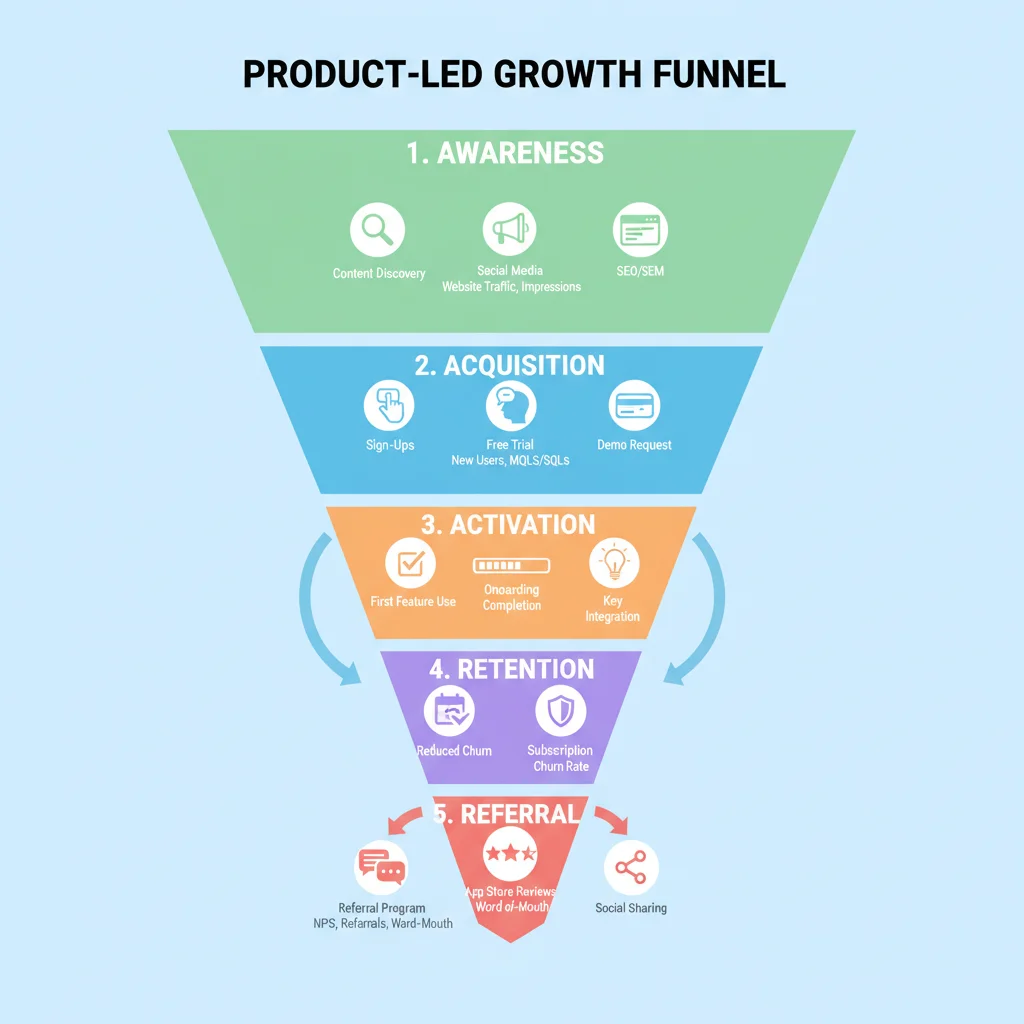
Implementing Your 90-Day Product-Led Growth Strategy Roadmap
Achieving a 35% boost in user engagement in just 90 days requires a focused, data-driven roadmap. Here’s a phased approach to implementing your product-led growth strategy:
Days 1-30: Discovery, Analysis, and Foundation Setting
The initial month is all about understanding your current state and laying the groundwork for rapid improvements.
- Deep Dive into Analytics (Days 1-7):
- Identify Current Engagement Baseline: Establish precise metrics for DAU, MAU, session duration, key feature adoption, and conversion rates. This is your starting point for the 35% growth target.
- Map the User Journey: Use analytics tools (e.g., Mixpanel, Amplitude, Google Analytics 4) to visualize user flows. Pinpoint where users drop off, get stuck, or fail to reach the ‘Aha!’ moment.
- Identify Your Current ‘Aha!’ Moment: Based on data, determine what actions correlate most strongly with long-term retention. Is it completing a specific task, inviting a team member, or integrating with another tool?
- Gather Qualitative Insights (Days 8-14):
- User Interviews: Conduct interviews with both highly engaged and disengaged users to understand their motivations, pain points, and perceptions of value.
- Surveys and Feedback Tools: Implement in-app surveys (e.g., NPS, CSAT) and feedback widgets to gather real-time sentiment.
- Support Ticket Analysis: Review common support inquiries to uncover areas of confusion or frustration within the product.
- Formulate Hypotheses and Prioritize (Days 15-21):
- Based on your data and qualitative insights, develop clear hypotheses about what improvements will most directly impact user engagement.
- Prioritize these hypotheses based on potential impact, effort required, and alignment with your ‘Aha!’ moment. Focus on high-impact, low-effort changes first.
- Team Alignment & Tooling (Days 22-30):
- Cross-Functional Workshop: Bring together product, engineering, marketing, and sales to align on the 90-day goal and the prioritized initiatives. Ensure everyone understands their role in the product-led growth strategy.
- Tooling Setup: Confirm your A/B testing tools, analytics platforms, and in-app messaging tools are properly configured and ready for rapid experimentation.
Days 31-60: Experimentation, Optimization, and Iteration
This is where the rubber meets the road. Focus on rapid experimentation and continuous improvement.
- Onboarding Optimization Sprints (Days 31-45):
- A/B Test Onboarding Flows: Experiment with different welcome messages, interactive guides, product tours, and sign-up field reductions.
- Highlight ‘Aha!’ Moment: Design changes to guide users more directly to their identified ‘Aha!’ moment. For example, pre-populate data or offer direct paths to core functionalities.
- Personalized Onboarding: If feasible, segment users and offer tailored onboarding experiences based on their initial input (e.g., role, industry).
- Feature Adoption & Usage Nudges (Days 46-60):
- In-App Messaging: Use targeted in-app messages to highlight underutilized features that provide significant value.
- Contextual Tooltips: Implement tooltips that appear when users hover over specific UI elements, providing just-in-time guidance.
- Gamification Elements: Introduce small gamified elements like progress bars for profile completion or badges for using key features.
- Empty State Design: Optimize empty states (e.g., an empty dashboard) to provide clear next steps and encourage action.
- Monitor and Analyze (Ongoing):
- Continuously monitor key engagement metrics. Use dashboards to visualize progress against your 35% target.
- Analyze the results of each A/B test. Learn from failures and scale successes.
Days 61-90: Retention, Expansion, and Refinement
The final month focuses on solidifying gains, improving retention, and setting the stage for future growth.
- Retention-Focused Initiatives (Days 61-75):
- Automated Nurturing: Set up automated email sequences or in-app messages to re-engage dormant users or remind them of product value.
- Value Reinforcement: Highlight new features or product updates that address common user pain points.
- Feedback Loop Refinement: Make it even easier for users to provide feedback and show them how their suggestions are being implemented.
- Expansion & Virality Drivers (Days 76-90):
- Referral Programs: Implement or optimize in-product referral programs that incentivize users to invite others.
- Shareable Content/Features: Identify opportunities for users to easily share their work or achievements created within your product on social media.
- Upsell/Cross-sell Opportunities: For freemium models, gently guide active free users towards premium features that solve advanced problems.
- Review and Plan (Days 85-90):
- 90-Day Review: Conduct a thorough review of all initiatives. Measure the overall increase in user engagement against your 35% target. Document key learnings.
- Future Roadmap: Based on your success and new insights, begin planning the next phase of your product-led growth strategy, focusing on sustained engagement and innovation.
This phased approach ensures that your efforts are strategic, measurable, and directly contribute to boosting user engagement. Remember, flexibility and a willingness to iterate based on real user data are paramount.

Key Metrics for Measuring Product-Led Growth Success
To effectively implement a product-led growth strategy, you must track the right metrics. These metrics go beyond traditional sales figures and focus on user behavior and product health.
- Activation Rate: The percentage of users who reach your product’s ‘Aha!’ moment. This is a critical indicator of onboarding effectiveness.
- Daily Active Users (DAU) / Monthly Active Users (MAU): These metrics measure how many unique users engage with your product on a daily or monthly basis, indicating overall product stickiness.
- Feature Adoption Rate: The percentage of active users who utilize specific key features. This helps identify valuable features and areas for improvement.
- Retention Rate: The percentage of users who return to your product over a specific period (e.g., week-over-week, month-over-month). High retention is the hallmark of a successful product-led growth strategy.
- Churn Rate: The inverse of retention, measuring the percentage of users who stop using your product. Minimizing churn is crucial.
- Time to Value (TTV): How quickly a new user experiences the core benefit of your product. A shorter TTV often leads to higher activation and retention.
- Net Promoter Score (NPS): Measures customer loyalty and willingness to recommend your product, indicating overall user satisfaction.
- Expansion Revenue: Revenue generated from existing customers through upgrades, cross-sells, or increased usage. This is a key indicator of product value and customer satisfaction.
Consistently monitoring and analyzing these metrics will provide the insights needed to refine your product-led growth strategy and ensure you are on track to meet your engagement goals.
The Future of Product-Led Growth: What to Expect Beyond 2026
While this guide focuses on 2026, the trajectory of product-led growth extends far beyond. We can anticipate several key trends shaping the future of this strategy:
- Hyper-Personalization at Scale: AI and machine learning will enable products to offer increasingly personalized experiences, guiding users to value based on their unique behavior patterns and preferences, almost anticipating their needs.
- Embedded AI and Automation: Products will become smarter, automating more tasks and providing intelligent suggestions, making them even more indispensable to users.
- Community-Led Growth Integration: The lines between product-led and community-led growth will blur further, with products facilitating stronger user communities that drive adoption, support, and advocacy.
- Ethical AI and Data Privacy: As products become more data-driven, ensuring ethical AI practices and robust data privacy will be paramount for maintaining user trust and compliance.
- No-Code/Low-Code Empowerment: The rise of no-code and low-code platforms will enable broader teams, including product managers and even advanced users, to create and customize product experiences, further democratizing product development.
- Sustainable Growth Models: A greater emphasis will be placed on building products that not only grow but do so sustainably, considering environmental and social impacts.
The core principle of putting the user and their experience first will remain constant, but the tools and techniques for achieving this will continue to evolve, making a product-led growth strategy an exciting and dynamic field.
Common Pitfalls to Avoid in Your Product-Led Growth Journey
While the benefits of a product-led growth strategy are immense, there are common traps that companies fall into. Being aware of these can help you navigate your journey more effectively:
- Ignoring the ‘Why’: Focusing solely on ‘how’ users use the product without understanding their underlying motivations and problems. Always start with the user’s need.
- Over-reliance on Freemium: Offering a free tier without a clear path to monetization or neglecting to define the value proposition of paid features. Your freemium must be a gateway, not a destination.
- Lack of Cross-Functional Alignment: Product, marketing, sales, and customer success teams working in silos. PLG requires seamless collaboration.
- Poor Data Infrastructure: Not having the right tools or expertise to collect, analyze, and act upon user data effectively. This leads to guesswork instead of informed decisions.
- Complex Onboarding: Overwhelming new users with too many features or a lengthy setup process, leading to high drop-off rates before they experience value.
- Neglecting Retention: Focusing purely on acquisition without investing in strategies to keep existing users engaged and happy. Retention is the bedrock of PLG.
- Feature Overload: Adding too many features without understanding user needs, leading to a bloated product that is difficult to navigate and use.
- Underestimating Support: Assuming a self-serve product means no need for robust customer support. Users will still have questions and need help.
By proactively addressing these potential pitfalls, you can build a more resilient and effective product-led growth strategy.
Conclusion: Embracing the Product-Led Future for 35% Engagement Growth
The year 2026 marks a pivotal moment where a robust product-led growth strategy is no longer an option but a necessity for companies aiming for sustainable success and exponential user engagement. By deeply understanding your users, optimizing every touchpoint from onboarding to ongoing value delivery, and relentlessly leveraging data, you can achieve and even surpass the ambitious goal of boosting user engagement by 35% in just 90 days.
Embracing PLG means fostering a culture where the product is seen as the ultimate growth engine, where every team member is aligned with user success, and where continuous iteration is the norm. It’s about building products that are so good, so intuitive, and so valuable that users can’t help but discover them, adopt them, and advocate for them. The future of growth is product-led, and the time to invest in this transformative approach is now. Start your journey today, and watch your user engagement soar.