US AI Regulations: Essential Compliance Steps by Q3 2026

The rapid advancement and widespread adoption of artificial intelligence (AI) have ushered in an era of unprecedented innovation and transformative potential across every sector. From enhancing operational efficiencies and personalizing customer experiences to powering scientific discoveries, AI’s capabilities are continually expanding. However, this technological marvel also presents complex challenges, particularly concerning ethics, data privacy, bias, and accountability. Recognizing these dual facets, governments worldwide are actively developing regulatory frameworks to harness AI’s benefits while mitigating its risks. The United States, a global leader in AI development, is no exception. The landscape of US AI regulations is evolving swiftly, transitioning from nascent discussions to concrete policy proposals and impending legislative actions.
For businesses operating within or interacting with the US market, understanding and preparing for these changes is no longer optional; it’s a critical imperative. The window for proactive compliance is narrowing, with significant deadlines, particularly by Q3 2026, looming large. Failure to adapt could result in substantial legal penalties, reputational damage, and a loss of competitive advantage. This comprehensive guide delves into the current state of US AI regulations, offering a strategic roadmap for businesses to navigate this intricate environment. We will explore the key drivers behind these regulations, dissect the primary areas of focus for policymakers, and, most importantly, outline five essential compliance steps your organization must undertake to ensure readiness by Q3 2026.
The goal is not merely to avoid penalties but to foster a culture of responsible AI development and deployment, building trust with customers and stakeholders, and ultimately leveraging AI as a force for good. As we embark on this detailed exploration, consider this your essential resource for understanding the complexities and seizing the opportunities presented by the new era of regulated AI.
The Evolving Landscape of US AI Regulations: A Snapshot
Unlike the European Union’s comprehensive and centralized approach with the AI Act, the US AI regulatory landscape is characterized by a more fragmented, yet increasingly coherent, strategy. It involves a patchwork of federal and state initiatives, executive orders, agency guidance, and legislative proposals. This distributed approach reflects the US’s federal system and its emphasis on sector-specific regulation. However, a clear trend towards increased oversight and accountability for AI systems is undeniable.
Key Drivers Behind US AI Regulations
Several critical factors are propelling the push for robust US AI regulations:
- Ethical Concerns: Widespread anxieties regarding algorithmic bias, discrimination, privacy erosion, and the potential for AI to be used in harmful ways are at the forefront. Reports of biased facial recognition systems, discriminatory lending algorithms, and privacy breaches have fueled public and political demand for safeguards.
- National Security: The strategic importance of AI for national defense, cybersecurity, and critical infrastructure has led to calls for regulations that secure AI supply chains, prevent misuse by adversaries, and ensure responsible development in sensitive areas.
- Economic Competitiveness: While fostering innovation remains paramount, policymakers also recognize the need to establish clear rules of the road to ensure fair competition, protect consumers, and maintain public trust, which is essential for sustained economic growth driven by AI.
- International Harmonization: As AI becomes a global phenomenon, there’s a growing recognition of the need for some level of international alignment in regulatory approaches to facilitate cross-border data flows and prevent regulatory arbitrage.
- Technological Maturity: As AI systems become more sophisticated and autonomous, their potential impact, both positive and negative, grows exponentially, necessitating more mature and comprehensive regulatory responses.
Recent Updates and Key Policy Directions
The past few years have seen significant movement in the US AI regulatory space:
- Executive Orders: President Biden’s Executive Order on the Safe, Secure, and Trustworthy Development and Use of Artificial Intelligence (October 2023) is a landmark directive. It sets broad principles, mandates federal agencies to develop AI safety and security standards, addresses AI-related risks in critical infrastructure, promotes fairness, and outlines responsible AI innovation. It directs agencies like NIST, OMB, and DHS to issue guidelines and rules, directly impacting businesses.
- National Institute of Standards and Technology (NIST): NIST has been instrumental in developing foundational resources like the AI Risk Management Framework (AI RMF). This voluntary framework provides a structured approach for organizations to identify, assess, and manage risks associated with AI systems. While voluntary, its principles are increasingly being woven into mandatory regulations and serve as a de facto standard.
- State-Level Initiatives: States like California (with the California Consumer Privacy Act, CCPA, and its extension, CPRA, which touch upon automated decision-making) and others are exploring or implementing their own AI-specific legislation, particularly concerning data privacy, algorithmic bias, and consumer protection.
- Sector-Specific Guidance: Regulatory bodies such as the FTC (Federal Trade Commission) and the EEOC (Equal Employment Opportunity Commission) have issued guidance on how existing laws (e.g., consumer protection laws, anti-discrimination laws) apply to AI systems. The FTC, for instance, has warned against deceptive AI practices and algorithmic bias.
- Legislative Proposals: Numerous bills have been introduced in Congress, proposing various aspects of AI regulation, from establishing a federal AI agency to mandating impact assessments and transparency requirements. While a comprehensive federal AI law has yet to pass, the momentum is building.
This dynamic environment underscores the urgency for businesses to establish robust AI governance frameworks. The deadline of Q3 2026 is not arbitrary; it aligns with the anticipated rollout of specific agency rules and the maturation of these foundational frameworks into enforceable standards.
5 Key Compliance Steps for Businesses by Q3 2026
To effectively navigate the evolving landscape of US AI regulations and ensure compliance by Q3 2026, businesses must adopt a proactive, multi-faceted strategy. Here are five essential steps:
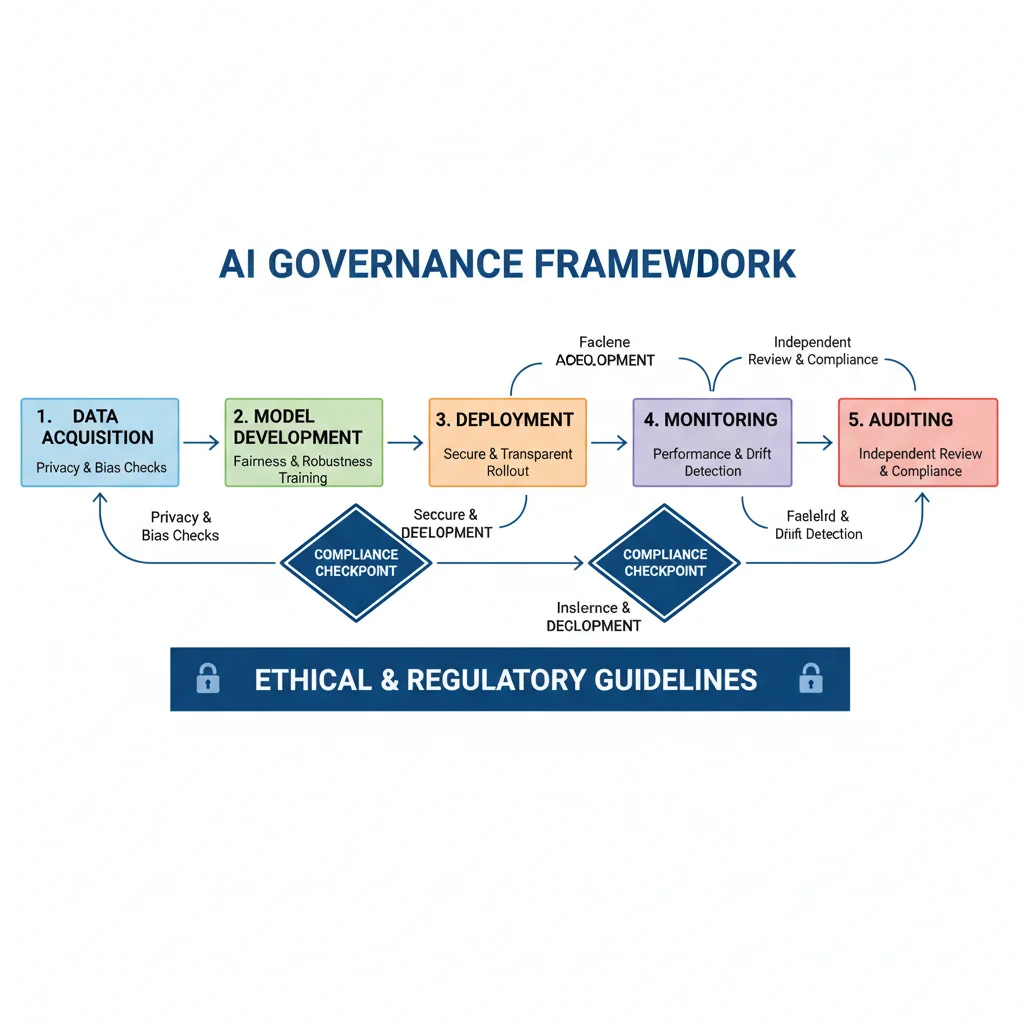
1. Establish a Robust AI Governance Framework
A strong AI governance framework is the bedrock of compliance. It provides the structure, policies, and processes necessary to manage AI risks and ensure ethical, legal, and responsible AI deployment throughout its lifecycle. This isn’t a one-time setup but an ongoing commitment to oversight.
What to Implement:
- Dedicated AI Governance Committee: Form a cross-functional committee comprising legal, ethics, data science, engineering, and business unit representatives. This committee will be responsible for setting AI policies, overseeing development, and ensuring compliance.
- Clear Policies and Procedures: Develop internal policies that align with emerging US AI regulations and best practices. These should cover data acquisition, model development, deployment, monitoring, and incident response. Specific policies for data privacy, algorithmic bias detection, transparency, and human oversight are crucial.
- Roles and Responsibilities: Clearly define who is accountable for different aspects of AI development and deployment. Assign roles such as ‘AI Ethics Officer’ or ‘AI Risk Manager’ to ensure dedicated oversight.
- AI Inventory and Risk Register: Maintain an up-to-date inventory of all AI systems in use or under development within the organization. For each system, create a risk register that identifies potential ethical, legal, security, and operational risks. Prioritize risks based on severity and likelihood.
- Training and Awareness Programs: Implement mandatory training for all employees involved in AI development, deployment, or decision-making. This training should cover ethical AI principles, regulatory requirements, and internal policies.
Why it’s Crucial by Q3 2026:
Regulatory bodies will expect to see demonstrable evidence of structured governance. Having a framework in place by Q3 2026 shows commitment and provides the operational backbone for implementing other compliance measures as specific rules solidify.
2. Implement Comprehensive Data Governance and Privacy Measures
AI systems are only as good, or as problematic, as the data they are trained on. Data governance is intrinsically linked to US AI regulations, particularly regarding privacy, bias, and fairness.
What to Implement:
- Data Minimization and Anonymization: Adopt principles of data minimization, collecting only the necessary data for AI models. Implement robust anonymization and pseudonymization techniques to protect sensitive personal information.
- Data Quality and Integrity: Ensure the data used for training and operating AI models is accurate, complete, and representative. Poor data quality can lead to biased outcomes and unreliable AI performance.
- Bias Detection and Mitigation: Develop and implement strategies to identify and mitigate biases in training data. This includes regular audits of data sources and statistical analysis for demographic representation and fairness metrics.
- Consent Management: Establish clear processes for obtaining and managing user consent for data collection and use, especially when personal data is involved in AI applications.
- Data Lineage and Audit Trails: Maintain detailed records of where data comes from, how it’s processed, and how it’s used by AI models. This audit trail is critical for demonstrating compliance and accountability.
- Compliance with Existing Data Privacy Laws: Ensure full compliance with existing and emerging data privacy laws like CCPA/CPRA, HIPAA, and any future federal privacy legislation, as these directly impact the data used by AI.
Why it’s Crucial by Q3 2026:
Data-related issues, especially bias and privacy breaches, are major targets for regulators. Proactive data governance not only prevents legal issues but also enhances the trustworthiness and effectiveness of your AI systems. By Q3 2026, expect stringent requirements around data provenance and bias mitigation.
3. Conduct Regular AI Risk Assessments and Impact Analyses
Identifying, assessing, and mitigating risks associated with AI systems is a core requirement of emerging US AI regulations. The NIST AI RMF provides an excellent starting point for this process.
What to Implement:
- AI Risk Assessment Methodology: Develop and formalize a methodology for conducting AI risk assessments. This should cover technical risks (e.g., model drift, adversarial attacks), ethical risks (e.g., discrimination, lack of transparency), legal risks (e.g., non-compliance), and societal risks.
- Algorithmic Impact Assessments (AIAs): For high-risk AI applications (e.g., those affecting employment, credit, healthcare, or public safety), conduct comprehensive AIAs. These assessments should evaluate the potential societal and individual impacts, identify mitigation strategies, and involve stakeholder consultation.
- Bias and Fairness Audits: Regularly audit AI models for fairness and bias, both during development and post-deployment. Utilize various fairness metrics and explainability tools to understand model behavior and identify discriminatory patterns.
- Cybersecurity for AI: Integrate AI systems into your broader cybersecurity framework. Protect AI models from data poisoning, model theft, and other adversarial attacks that could compromise their integrity or lead to harmful outcomes.
- Continuous Monitoring and Re-evaluation: AI models are not static. Implement continuous monitoring systems to detect model drift, performance degradation, and emerging biases. Regularly re-evaluate risk assessments as models evolve or are deployed in new contexts.
Why it’s Crucial by Q3 2026:
Regulators are increasingly requiring businesses to demonstrate due diligence in identifying and mitigating AI risks. The Executive Order explicitly mandates federal agencies to develop requirements for AI safety and security, which will trickle down to businesses. Having a robust risk assessment process by Q3 2026 will be essential for demonstrating responsible AI practices.
4. Prioritize Transparency, Explainability, and Human Oversight
The ‘black box’ nature of some advanced AI models is a significant concern for regulators. Transparency, explainability (XAI), and meaningful human oversight are key principles underpinning responsible US AI regulations.
What to Implement:
- Explainable AI (XAI) Techniques: Where appropriate, integrate XAI techniques into your AI development pipeline. This allows for a better understanding of how AI models arrive at their decisions, which is crucial for debugging, auditing, and building trust.
- Human-in-the-Loop Mechanisms: For critical or high-stakes AI applications, design systems with meaningful human oversight. This means humans should have the ability to review, override, or intervene in AI decisions, especially in cases where the AI’s impact is significant.
- Clear Communication and Disclosure: Be transparent with users and affected individuals about when and how AI is being used. Provide clear, understandable explanations of AI’s purpose, limitations, and potential impacts. This includes clear opt-out mechanisms where applicable.
- Documentation of AI Systems: Maintain comprehensive documentation for each AI system, including its purpose, data sources, model architecture, training methodology, performance metrics, and any fairness or bias mitigation strategies employed. This documentation is vital for audits and accountability.
- Feedback Mechanisms: Establish channels for users and stakeholders to provide feedback on AI system performance, potential issues, or perceived biases. This feedback loop is essential for continuous improvement and building trust.
Why it’s Crucial by Q3 2026:
The push for transparency and explainability is strong within US policy circles. The Executive Order emphasizes promoting transparency in AI development and use. By Q3 2026, businesses should be able to demonstrate how their AI systems are understandable, accountable, and subject to human control, particularly in high-impact scenarios.

5. Engage with Legal Counsel and Stay Informed
The US AI regulatory landscape is dynamic and complex. Staying informed and seeking expert legal advice is paramount for effective compliance.
What to Implement:
- Dedicated Legal Counsel: Engage legal professionals specializing in AI law, data privacy, and technology regulations. They can provide tailored advice, interpret complex regulations, and guide your compliance efforts.
- Continuous Monitoring of Regulatory Updates: Subscribe to regulatory alerts, industry newsletters, and legal analyses to stay abreast of new legislation, agency guidance, and enforcement actions at both federal and state levels.
- Industry Collaboration and Best Practices: Participate in industry forums, working groups, and professional associations focused on AI ethics and regulation. Sharing and learning best practices can accelerate your compliance journey.
- Scenario Planning and Audits: Conduct regular internal audits of your AI systems and processes against anticipated regulatory requirements. Engage in scenario planning to understand potential impacts of different regulatory outcomes.
- Advocacy and Policy Engagement: Consider engaging in policy discussions through industry associations or direct channels. Providing input can help shape future regulations in a way that is both effective and practical for businesses.
Why it’s Crucial by Q3 2026:
The fragmented nature of US AI regulations means that a single misstep can have significant consequences. Legal expertise ensures that your compliance strategy is sound and adaptable. By Q3 2026, clarity on certain federal and state rules will emerge, making informed legal guidance indispensable for final preparations.
Beyond Compliance: Building Trust and Innovation
While the immediate focus on US AI regulations is driven by the need to avoid penalties and manage risk, businesses should view compliance as an opportunity rather than merely a burden. Adhering to ethical and legal AI standards can significantly enhance consumer trust, strengthen brand reputation, and foster sustainable innovation.
Companies that prioritize responsible AI are more likely to gain a competitive edge. Consumers and business partners are increasingly scrutinizing how AI is developed and deployed. Demonstrating a commitment to fairness, transparency, and accountability can differentiate your organization in the marketplace.
Moreover, a well-defined AI governance framework, while initially requiring investment, ultimately leads to more robust, reliable, and effective AI systems. It reduces the likelihood of costly errors, biases, and legal disputes, allowing your teams to innovate with confidence and clarity. By embedding ethical considerations from the design phase, organizations can develop AI solutions that not only comply with regulations but also genuinely serve societal good and drive long-term value.
Conclusion
The landscape of US AI regulations is undergoing a profound transformation, moving towards a more structured and accountable approach to artificial intelligence. For businesses, the period leading up to Q3 2026 represents a critical window to implement the necessary frameworks and processes to ensure compliance. The five key steps outlined – establishing robust AI governance, implementing comprehensive data governance, conducting regular risk assessments, prioritizing transparency and human oversight, and engaging with legal counsel – are not just checkboxes but foundational pillars for responsible AI development.
Proactive engagement with these compliance measures will not only mitigate legal and reputational risks but also position your organization as a leader in ethical AI. As AI continues to reshape industries and societies, those businesses that embrace responsible practices will be best equipped to harness its full potential, build enduring trust with stakeholders, and thrive in the new era of regulated artificial intelligence. The time to act is now; preparing for Q3 2026 means laying the groundwork today for a future where AI is both innovative and trustworthy.