Ethical AI Implementation: 2026 Guide for US Businesses

The 2026 Guide to Ethical AI Implementation: Avoiding Common Pitfalls and Ensuring Business Integrity in the US
The rapid evolution of Artificial Intelligence (AI) presents unparalleled opportunities for businesses across the United States. From optimizing operations to revolutionizing customer experiences, AI’s potential is boundless. However, as AI systems become more integrated into critical business functions, the imperative for ethical AI implementation grows exponentially. By 2026, navigating the complex landscape of AI ethics will not just be a moral consideration but a strategic necessity for maintaining trust, ensuring compliance, and safeguarding business integrity. This comprehensive guide delves into the core principles, common pitfalls, and best practices for achieving robust ethical AI implementation in the US business environment.
The conversation around AI has shifted dramatically in recent years. What was once a futuristic concept is now a daily reality for many organizations. With this widespread adoption comes increased scrutiny from regulators, consumers, and civil society. High-profile incidents of AI bias, privacy breaches, and opaque decision-making have highlighted the urgent need for a proactive and principled approach to AI development and deployment. For US businesses, this means understanding not only the technological aspects of AI but also its profound societal implications. The stakes are incredibly high: reputational damage, significant fines, loss of customer trust, and even legal action can result from neglecting ethical considerations in AI. Therefore, prioritizing ethical AI implementation is paramount for long-term success and sustainability.
Understanding the Landscape of Ethical AI in 2026
As we look towards 2026, the regulatory and societal expectations around AI ethics are becoming clearer and more stringent. While the US currently lacks a single, overarching federal AI law akin to Europe’s AI Act, a patchwork of state-level regulations, industry-specific guidelines, and federal agency guidance is rapidly emerging. Businesses must contend with various frameworks, including those addressing data privacy (like CCPA and emerging state laws), algorithmic fairness, and consumer protection. Understanding this multifaceted environment is the first step towards effective ethical AI implementation.
Key areas of focus for US businesses in 2026 will include:
- Data Privacy and Security: Ensuring that AI systems process personal data responsibly, in compliance with evolving privacy laws.
- Algorithmic Fairness and Bias Mitigation: Actively identifying and addressing biases in training data and algorithms to prevent discriminatory outcomes.
- Transparency and Explainability: Making AI decisions understandable and justifiable to stakeholders, especially when those decisions impact individuals.
- Accountability and Human Oversight: Establishing clear lines of responsibility for AI system performance and ensuring human intervention capabilities.
- Robustness and Safety: Developing AI systems that are reliable, secure, and resilient to adversarial attacks or unintended malfunctions.
These pillars form the foundation of responsible AI practices and are critical for any organization seeking to implement AI ethically and effectively. Ignoring any of these aspects can lead to significant ethical breaches and operational setbacks. Therefore, a holistic strategy for ethical AI implementation is not optional but essential.
Common Pitfalls in Ethical AI Implementation and How to Avoid Them
Even with the best intentions, businesses can stumble when integrating AI. Recognizing common pitfalls is crucial for proactive risk mitigation. Here are some of the most frequent challenges and strategies to overcome them:
Pitfall 1: Neglecting Data Governance and Quality
Problem: AI models are only as good as the data they’re trained on. Using biased, incomplete, or poorly managed data can lead to discriminatory outcomes, privacy violations, and inaccurate predictions. Many organizations rush into AI development without sufficient attention to their data pipelines.
Solution for Ethical AI Implementation: Establish robust data governance frameworks from the outset. This includes clear policies for data collection, storage, usage, and retention. Implement data quality checks, bias auditing tools, and regular data provenance tracking. Invest in diverse data sets and work to identify and mitigate historical biases present in existing data. A strong foundation in data ethics is non-negotiable for successful ethical AI implementation.
Pitfall 2: Lack of Transparency and Explainability
Problem: Many advanced AI models, particularly deep learning networks, are often perceived as ‘black boxes,’ making it difficult to understand how they arrive at their decisions. This lack of transparency erodes trust, hinders accountability, and complicates debugging or auditing processes, especially when decisions affect individuals’ lives (e.g., loan applications, hiring).
Solution for Ethical AI Implementation: Prioritize explainable AI (XAI) techniques where appropriate. While full explainability might not always be possible or necessary for every AI application, strive for a level of transparency commensurate with the risk and impact of the AI system. Document model architecture, training data, and decision logic. Implement tools that can provide insights into feature importance or decision paths. Clearly communicate the limitations and capabilities of AI systems to users and affected parties. This commitment to transparency is a cornerstone of responsible ethical AI implementation.
Pitfall 3: Ignoring Algorithmic Bias
Problem: Algorithmic bias occurs when an AI system’s output reflects or amplifies societal biases present in its training data or design. This can lead to unfair treatment of certain demographic groups, perpetuating discrimination in areas like hiring, credit scoring, or criminal justice. This is one of the most significant challenges in ethical AI implementation.
Solution for Ethical AI Implementation: Implement a comprehensive bias detection and mitigation strategy. This involves:
1. Pre-processing: Cleaning and balancing data sets to reduce inherent biases.
2. In-processing: Using algorithms designed to be fair, or incorporating fairness constraints during model training.
3. Post-processing: Adjusting model outputs to ensure fairness metrics are met.
Regularly audit AI systems for disparate impact and outcomes across different demographic groups. Engage diverse teams in the development process to bring varied perspectives and identify potential biases early on. Cultivating a culture that actively seeks out and addresses bias is critical for ethical AI implementation.
Pitfall 4: Insufficient Human Oversight and Accountability
Problem: Over-reliance on autonomous AI systems without adequate human oversight can lead to disastrous consequences. When things go wrong, it can be unclear who is responsible, leading to a breakdown in accountability. This can be a major hurdle for ethical AI implementation.
Solution for Ethical AI Implementation: Design AI systems with ‘human-in-the-loop’ mechanisms. This means ensuring that humans can review, intervene, and override AI decisions, especially in high-stakes scenarios. Clearly define roles and responsibilities for AI development, deployment, and monitoring. Establish an AI ethics committee or review board within the organization. Implement robust logging and auditing capabilities to track AI system performance and human interventions. Accountability must be baked into the very fabric of your ethical AI implementation strategy.
Pitfall 5: Lack of Stakeholder Engagement
Problem: Developing AI in a silo, without engaging affected stakeholders (employees, customers, community groups), can lead to systems that fail to meet real-world needs, create unintended negative consequences, or face significant public backlash. This oversight can derail even the most well-intentioned ethical AI implementation efforts.
Solution for Ethical AI Implementation: Foster a culture of open dialogue and engagement. Involve diverse stakeholders throughout the AI lifecycle, from conception to deployment and ongoing monitoring. Conduct impact assessments that consider societal, environmental, and ethical implications. Solicit feedback and incorporate it into iterative development cycles. Proactive communication about AI’s purpose, benefits, and limitations can build trust and acceptance, reinforcing the value of ethical AI implementation.
Key Strategies for Ensuring Business Integrity with Ethical AI Implementation
Beyond avoiding pitfalls, proactive strategies are essential for embedding ethics into the core of your AI initiatives. These strategies will ensure that your ethical AI implementation efforts contribute positively to your business integrity and societal impact.
1. Develop a Comprehensive AI Ethics Policy and Governance Framework
Every organization engaging with AI should have a clear, documented AI ethics policy. This policy should articulate the company’s commitment to responsible AI, outline core ethical principles (e.g., fairness, transparency, privacy, accountability), and provide guidelines for AI development and deployment. Complement this with a robust governance framework that defines roles, responsibilities, and decision-making processes for AI ethics. This includes establishing an AI ethics committee, designating an AI ethics officer, or integrating ethics considerations into existing risk management structures. A well-defined policy and framework provide the necessary structure for consistent ethical AI implementation.
2. Implement AI Ethics Training and Awareness Programs
Ethical AI is not solely the responsibility of data scientists or engineers; it’s a company-wide endeavor. All employees involved in the AI lifecycle, from product managers to legal teams and senior leadership, need to understand the ethical implications of AI. Conduct regular training programs that cover AI ethics principles, potential biases, regulatory requirements, and the company’s specific policies. Foster a culture where ethical considerations are part of every discussion about AI. Educating your workforce is a powerful step towards effective ethical AI implementation.
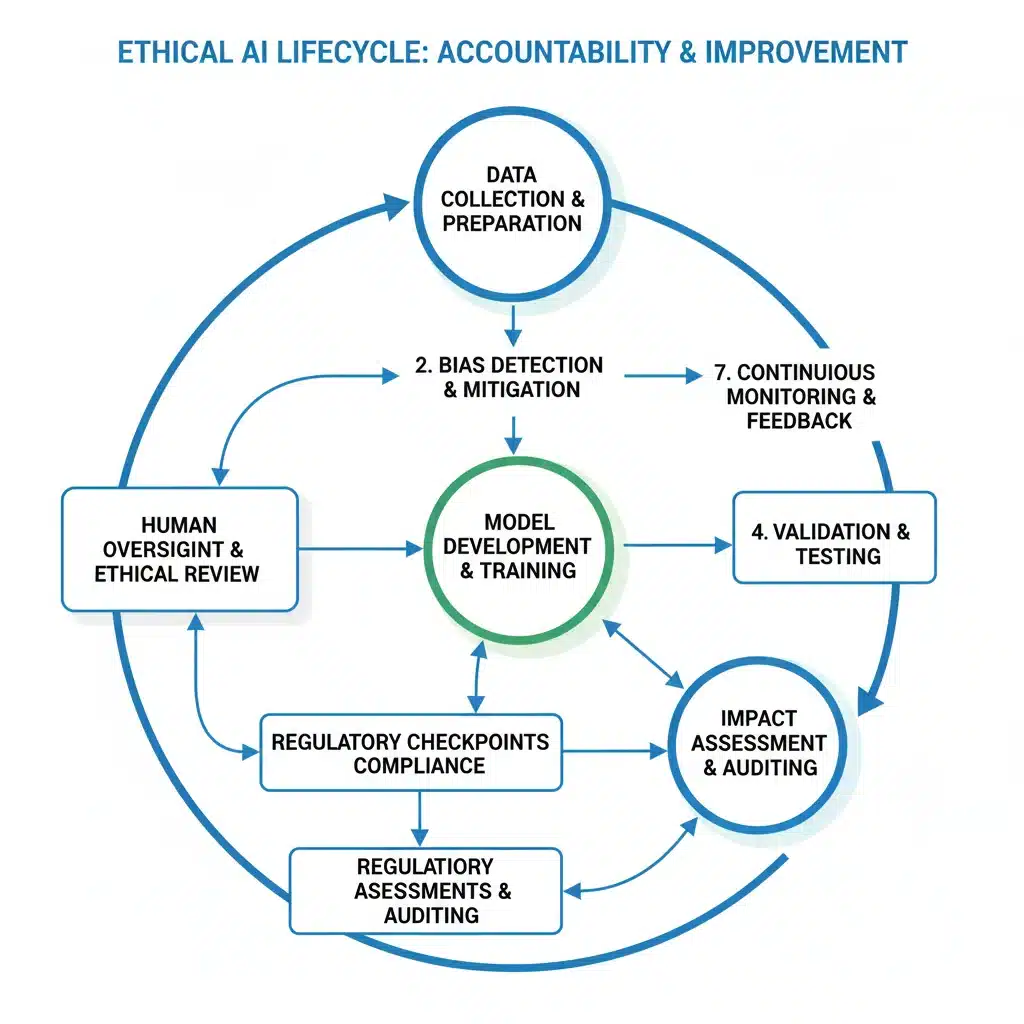
3. Integrate Ethics into the AI Lifecycle (Ethical AI by Design)
Ethical considerations should not be an afterthought but rather integrated into every stage of the AI lifecycle, from ideation and data collection to model development, deployment, and monitoring. This concept, often referred to as ‘Ethical AI by Design’ or ‘Responsible AI by Design,’ ensures that ethics are a foundational element. For example, during the design phase, conduct ethical impact assessments. During data collection, ensure informed consent and data anonymization. In development, use fairness-aware algorithms and conduct bias audits. Post-deployment, continuously monitor for unintended consequences and performance drift. This proactive approach is fundamental for sustainable ethical AI implementation.
4. Prioritize Privacy-Preserving AI Techniques
With increasing data privacy regulations, incorporating privacy-enhancing technologies (PETs) into your AI strategy is crucial. Techniques like differential privacy, federated learning, and homomorphic encryption allow AI models to be trained and operated while minimizing the exposure of sensitive personal data. By adopting these methods, businesses can leverage the power of AI without compromising individual privacy, thereby strengthening their commitment to ethical AI implementation and building customer trust.
5. Establish Continuous Monitoring and Auditing Mechanisms
AI systems are not static; they evolve as they interact with new data and environments. Therefore, continuous monitoring is vital to detect and address emerging ethical issues. Implement automated tools for monitoring model performance, detecting bias drift, and identifying anomalies. Conduct regular independent audits of AI systems to ensure compliance with ethical guidelines, regulatory requirements, and internal policies. These audits should not only check for technical performance but also assess societal impact. A robust monitoring and auditing framework is indispensable for ongoing ethical AI implementation.
6. Engage with External Experts and Collaborate on Best Practices
The field of AI ethics is rapidly evolving. Staying abreast of the latest research, best practices, and regulatory developments can be challenging for any single organization. Engage with external AI ethics experts, academics, and industry consortia. Participate in industry groups and contribute to the development of shared standards and guidelines. Collaboration can provide valuable insights, help identify blind spots, and foster a collective approach to responsible AI. This external engagement is a critical component of leading the way in ethical AI implementation.
The Regulatory Landscape for Ethical AI in the US by 2026
The US regulatory environment for AI is dynamic and complex. While a comprehensive federal AI law has yet to materialize, several key developments indicate the direction of future mandates for ethical AI implementation:
- National Institute of Standards and Technology (NIST) AI Risk Management Framework (AI RMF): This voluntary framework provides guidance for managing risks associated with AI, offering a structured approach for organizations to incorporate trustworthy AI principles into their operations. Many businesses are already aligning their internal policies with NIST’s recommendations.
- State-Level Initiatives: States like Colorado, New York, and California are pioneering legislation concerning AI, particularly regarding algorithmic fairness in hiring, insurance, and critical decision-making. These state laws often precede federal action and signal areas of future compliance for ethical AI implementation.
- Federal Agency Guidance: Various federal agencies, including the FTC, EEOC, CFPB, and FDA, are issuing guidance and taking enforcement actions related to AI’s impact on consumer protection, anti-discrimination, financial services, and healthcare. These agencies are actively scrutinizing AI use cases and holding companies accountable for biased or unfair practices.
- Executive Orders and AI Bills: The Biden administration has issued executive orders emphasizing responsible AI innovation and calling for agencies to develop AI policies. Numerous AI-related bills are also under consideration in Congress, signaling a growing legislative interest in areas like algorithmic accountability, data privacy, and national security implications of AI.
For US businesses, this means adopting a proactive and adaptive approach. Instead of waiting for prescriptive federal laws, organizations should build their ethical AI implementation strategies around anticipated regulatory trends and existing best practices. A strong ethical foundation will not only ensure compliance with current and future regulations but also position businesses as leaders in responsible innovation.

Building a Culture of Responsible AI
Ultimately, successful ethical AI implementation goes beyond policies and technical solutions; it requires cultivating a deep-seated culture of responsibility within the organization. This culture should permeate every level, from the executive suite to individual contributors. It means encouraging critical thinking about AI’s impact, rewarding ethical behavior, and creating safe spaces for employees to raise concerns without fear of reprisal.
Key elements of a responsible AI culture include:
- Leadership Commitment: Ethical AI must be championed from the top. Leadership’s visible commitment signals its importance to the entire organization.
- Cross-Functional Collaboration: AI ethics is not just for tech teams. Legal, HR, marketing, and customer service departments all have a role to play in ensuring ethical outcomes.
- Continuous Learning and Adaptation: The field of AI ethics is constantly evolving. A culture of continuous learning ensures that the organization remains agile and responsive to new challenges and best practices.
- Openness and Dialogue: Encourage open discussions about the ethical implications of AI projects. Create mechanisms for employees to voice concerns and contribute to ethical problem-solving.
- Prioritizing Impact Over Innovation at All Costs: While innovation is crucial, it should not come at the expense of ethical considerations. Prioritize the well-being of individuals and society in AI development.
By fostering such a culture, businesses can ensure that ethical AI implementation becomes an intrinsic part of their operational DNA, leading to more resilient, trustworthy, and ultimately, more successful AI initiatives.
The Business Benefits of Proactive Ethical AI Implementation
While the focus on ethical AI often highlights risk mitigation, it’s crucial to recognize the significant business advantages that come with a proactive approach to ethical AI implementation:
- Enhanced Brand Reputation and Trust: In an increasingly AI-driven world, consumers and partners are more likely to engage with organizations perceived as ethical and responsible. A strong commitment to AI ethics can be a powerful differentiator.
- Competitive Advantage: Businesses that lead in ethical AI will be better positioned to attract top talent, secure partnerships, and gain market share as ethical considerations become a mainstream purchasing factor.
- Reduced Legal and Regulatory Risks: Proactive compliance with ethical guidelines and anticipated regulations minimizes the risk of costly fines, lawsuits, and reputational damage.
- Improved Customer Loyalty: Transparent and fair AI systems build trust, leading to stronger customer relationships and greater loyalty.
- Better Decision-Making and Innovation: Ethical AI systems, built on diverse data and fair algorithms, tend to be more robust, accurate, and innovative, leading to better business outcomes.
- Attracting and Retaining Talent: Professionals, particularly in technology, are increasingly seeking employers who demonstrate a strong commitment to ethical practices.
Therefore, viewing ethical AI implementation not as a burden but as an investment in future success is a critical mindset shift for businesses in the US.
Conclusion: Charting a Course for Responsible AI in 2026 and Beyond
The journey towards comprehensive ethical AI implementation is ongoing and requires continuous vigilance and adaptation. By 2026, US businesses will face a more mature and demanding landscape, characterized by evolving regulations, heightened public scrutiny, and a greater understanding of AI’s societal impact. The organizations that thrive will be those that have proactively embedded ethics into every facet of their AI strategy.
From establishing robust data governance and mitigating algorithmic bias to fostering transparency, ensuring human oversight, and building a culture of responsibility, every step contributes to stronger business integrity. The benefits extend beyond mere compliance, offering significant advantages in brand reputation, competitive positioning, and sustainable innovation. As AI continues to reshape industries and societies, the commitment to ethical AI implementation will not just be a best practice; it will be the cornerstone of responsible and successful business operations in the United States.
Embrace the challenge, understand the landscape, and commit to a future where AI serves humanity ethically and effectively. Your business integrity depends on it, and the future of responsible AI development in the US hinges on these crucial decisions made today.